18 ft fishing boat · 300 mi · overland
Fixed loading fee + per-mile rate for 18 ft × 300 mi + fuel
$321 – $563 · ≈ $1.47/mile
Estimates for a 24 ft center console (8.5 ft beam) on a carrier-supplied trailer, marina to marina. Run your own boat in the calculator above for an exact range.
Estimates from this site's published formula, not past bookings or carrier quotes. Browse all routes
The calculator prices all three. Here's what each one involves.
 Overland by truck
How most boats move. The carrier brings a trailer and hauls door to door. Boats wider than 8′6″ need an oversize permit in every state crossed.
Transport by city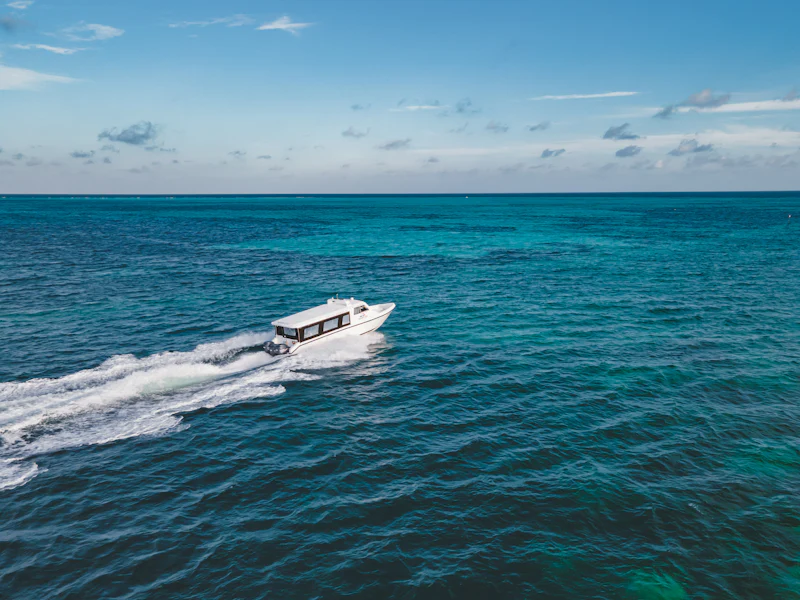 Delivered by water
A licensed USCG captain runs the boat port to port. You cover fuel and the captain's return travel, so it suits larger boats on coastal routes.
Delivery guides Marina to marina
Most hauls start and end at a marina with a travelift, at roughly $16–$22 per foot each end. A driveway pickup needs a mobile crane instead.
Find a marinaPhotos: Thomas Cremas, Ibrahim Shabil, Matthew Jackson on Unsplash
Boat shipping rates follow the boating season. Hauling in the off-peak window (October through March) typically runs about 10% below summer rates — a few hundred dollars on a typical trailerable move, more on large yachts.
Sub-freezing highway temperatures at 65 MPH will crack engine blocks and water lines. Always drain fresh water systems, pump marine antifreeze through cooling manifolds, and empty blackwater tanks.
Winter highways are coated in corrosive road salt, grit, and slush. Professional shrink wrapping with belly bands prevents caustic salt spray from etching your gelcoat and corroding exposed hardware.
The highest savings occur on northbound hauls in November/December and southbound hauls in February/March when carriers travel empty to stage trailers.
Don't risk a six-figure investment with unvetted haulers. Use our 4-pillar verification framework to verify carrier credentials, DOT licensing, and cargo coverage before signing.
Every commercial interstate boat transporter MUST hold active operating authority with the Federal Motor Carrier Safety Administration.
Never assume a hauler's personal auto policy covers your boat. Commercial marine cargo policies must explicitly protect your vessel hull.
The Bill of Lading is your legal transport contract and the foundation of any insurance claim. Strict pre-trip documentation is mandatory.
Boats cannot simply be lashed to flatbed freight trailers without specialized hull bunks, keel supports, and oversized state permits.
Ask any prospective hauler for their 6-digit MC number or 7-digit USDOT number. You can verify their live safety score and active insurance filings on the official federal SAFER database for free.
Explore our complete suite of boat shipping, transport, and finance calculators.
Estimate overland, in-water, and ocean freight costs for your boat.
Determine if your boat requires wide-load permits and escorts.
Calculate costs for shipping boats overseas via RoRo or container.
Calculate monthly and annual marina docking costs by region.
Estimate monthly payments for your boat financing.
Break down your total by size, distance, method, and season.
Follow the exact steps to get your result instantly and privately.
Add your boat's length, beam, and the shipping distance in miles. Height and weight are optional.
Staring at a massive transport bill? Human brains don't naturally process weird variable rates, but the math behind boat shipping is actually pretty straightforward. Because every shipment is unique, transport companies typically calculate quotes using a combination of physical specifications, logistical requirements, and market variables. Boat shipping starts from a simple base — a rate per mile multiplied by the distance.
Vessel specifications are the most significant factor in your cost estimate. That per-mile rate climbs with boat size: trailerable boats run roughly $0.75–$2.00 per mile all-in on long hauls, and the calculator's base rate rises from about $0.80 per mile for boats under 20 ft to $1.23 for 20–35 ft, $1.99 for 35–55 ft and $3.07 for yachts over 55 ft (typical figures, before permits, fuel and season). A beam over 8.5 ft triggers oversize-load permits ($50–$250 per state) and may require specialized route planning or escort vehicles, which significantly raise the price. Heavier boats also require more powerful towing vehicles and specialized lifting equipment.
The distance and route play a major role as well. Every job carries a fixed loading charge — about $150–$300 for a 20–24 ft boat and $700–$1,000 for a 32–36 ft boat — so short hauls cost the most per mile and long hauls the least. Furthermore, if your route involves narrow roads, bridges, or difficult terrain that limits accessibility, costs will rise due to the extra time and handling required.
Finally, seasonality, transport method, and additional variables can shift the final number. Spring and summer add roughly a 10% peak demand premium. Transporting your boat in-water is generally 15% cheaper than overland hauling, while ocean freight multiplies the base rate by roughly 2.5×. You must also account for fuel prices, which are often passed on to customers via an 8% surcharge. Run the numbers here before you call a single hauler to ensure you get a fair price.
Base Cost = Fixed Loading Fee (grows with length) + Rate per Mile (grows with length) × Distance
  × Beam Multiplier       (over 8.5 ft +20%, over 10 ft +30%, over 12 ft +45%)
  × Season Multiplier     (peak +10%, off-peak ×1.0)
  × Transport Method      (in-water −15%, ocean +150%)
  + Fuel Surcharge        (8% of base)
+ Permit Fees (if beam > 8.5 ft)For example: A 28 ft boat with a 10 ft beam shipped 800 miles overland in summer, crossing 3 states, comes out at about $2,000 base at the mid-point once the fixed loading fee, the per-mile rate for its length, the wide-beam and peak-season adjustments are applied. Add the fuel surcharge and 3 oversize permits ($450) and the estimate lands at roughly $2,140–$3,460. Rates are calibrated against real completed boat transports.
Sample scenarios and their calculated results — or load one straight into the calculator above.
Fixed loading fee + per-mile rate for 18 ft × 300 mi + fuel
$321 – $563 · ≈ $1.47/mile
Size-scaled rate × 1,200 mi × wide beam × peak season + fuel + 4 permits ($600)
$4,217 – $6,821 · ≈ $4.60/mile
Size-scaled loading fee + rate × 500 mi × wide beam + fuel + 3 permits + escort
$5,353 – $6,810 · ≈ $12.16/mile
Size-scaled rate × 600 mi × 0.85 (in-water) + fuel
$924 – $1,561 · ≈ $2.07/mile
Size-scaled rate × 3,000 mi × 2.50 (ocean) + fuel
$28,008 – $48,111 · ≈ $12.69/mile
| Boat Size | 500 Miles | 1,000 Miles | 2,000 Miles | Rate/Mile (mid) |
|---|---|---|---|---|
| Small (under 20 ft) | $506 | $907 | $1,711 | $0.80 |
| Mid-Size (20–35 ft) | $986 | $1,600 | $2,830 | $1.23 |
| Large (35–55 ft) | $2,558 | $3,551 | $5,536 | $1.99 |
| Yacht (55+ ft) | $7,339 | $8,876 | $11,948 | $3.07 |
For per-mile rates by boat size, oversize permit fees and seasonal pricing, see our boat shipping cost guide.
Founder & Editor
Rizwan Malik founded Boat Shipping Cost Calculator and edits every guide on it. He built the calculator's rate formula and keeps it current against published carrier and marketplace rates, FMCSA carrier records and state DOT permit rules.
Boat shipping runs about $0.75 to $2.00 per mile for trailerable boats and up to $10–$15 per mile for large yachts. We break down 2026 overland rates, oversize permit triggers, and seasonal fees.
The exact beam and height numbers that trigger oversize permits and pilot car escorts for boat transport, what each state actually charges, and the weekend curfews that can delay your delivery.
How to verify a boat transporter's USDOT number, MC operating authority, and cargo insurance on FMCSA SAFER before you hand over the keys — plus the Bill of Lading habits that actually protect a claim.
Shipping a trailerable boat costs about $0.75 to $2.00 per mile on long hauls in 2026, typically around $1.35, according to the Boat Shipping Cost Calculator benchmark. By size, the base rate is about $0.80 per mile for boats under 20 ft, $1.23 for 20–35 ft, $1.99 for 35–55 ft and $3.07 for yachts over 55 ft. Overall trip costs run about $300–$700 for short hauls (under 250 miles) to roughly $2,200–$4,600 cross-country for a 22 ft boat and $4,200–$8,200 for a 30 ft wide-beam boat, plus state oversize permits and a fuel surcharge that tracks current diesel prices.
According to 2026 industry rate data compiled by Boat Shipping Cost Calculator, the base rate for boat hauling on long routes is about $0.55–$1.25 per mile for small boats under 20 ft (typically $0.80), $0.84–$1.91 for 20–35 ft boats (typically $1.23), $1.36–$3.09 for 35–55 ft boats (typically $1.99) and $2.10–$4.79 for yachts over 55 ft (typically $3.07). Oversize permits, escorts, the fuel surcharge and the peak-season premium come on top. These figures are calibrated against real completed boat transports booked between October 2025 and June 2026.
A beam over 8.5 ft triggers oversize-load permits in every state you cross, at $50–$250 per state. Short hauls cost more per mile because setup and permitting are fixed, peak season (April–September) adds about 10%, fuel surcharges add about 8%, and ocean freight multiplies the base rate by roughly 2.5×.
Yes. Once a boat's beam passes 8.5 ft it counts as an oversize load, and each state it travels through requires its own permit — typically $50–$250 apiece. Very tall loads over about 13.5 ft of road clearance can also need height permits and route surveys.
Fall and winter (October–March) avoid the spring/summer premium and usually price about 10% lower. If your schedule is flexible, shipping in the off-season is the single easiest way to cut the bill.
For seven more ways to lower the price, see the cheapest way to ship a boat.
Overland moves the boat on a truck and trailer and can reach almost any address, but it triggers permits for wide loads. In-water transport runs the boat from marina to marina and costs about 15% less, though it only works for boats that can be crewed or moved under their own power.
Use the free online Boat Shipping Cost Calculator as your baseline rate benchmark, then request bids from FMCSA-licensed boat haulers, checking each one's USDOT and MC numbers on the FMCSA SAFER site. Giving carriers your exact length, beam, loaded height, and weight gets you faster, firmer quotes.
The whole process, step by step: how to ship a boat.
Yes. The estimate adds a fuel surcharge based on the current national diesel price and, for overland moves with a beam over 8.5 ft, oversize permit fees for the states you cross. Add your boat's value and it also estimates insurance. It does not include marina haul-out, blocking, or storage fees.
To calculate boat transport cost, multiply the carrier's rate per mile by the total distance of the trip. Then, add seasonal surcharges (about 10% in summer), fuel surcharges (typically 8-10%), and state-specific oversize permit fees if your boat's beam exceeds 8.5 feet.
The primary factors affecting boat shipping prices are total distance, boat dimensions (length, beam, height, and weight), seasonality (peak vs. off-peak), transport method (overland, in-water, or ocean freight), and fuel costs. Oversize boats require special permits and escort vehicles, which significantly raise the final price.
For international moves, container shipping is often cheaper than Roll-on/Roll-off (RoRo) or overland freight, but it requires the sailboat to fit within standard container dimensions (usually a 40ft container). This typically means the mast must be unstepped and the keel may need to be removed to fit the strict height and width limits.
Get at least three bids from licensed haulers: local boat transport companies, owner-operators, and online load marketplaces all work. Run your trip through this calculator first so you know a fair price, then check each carrier's USDOT number and cargo insurance on the FMCSA SAFER site before booking. Being flexible on dates and shipping off-peak usually gets the lowest price.
Moving house at the same time? Most household movers won't take anything bigger than a kayak or dinghy. See can movers move a boat for who will, and what it costs.
Most commercial marinas charge between $12 and $25 per foot for Travelift haul-out or splash services, depending on whether blocking, power-washing, or transient dry storage is required. For a 32-foot boat, plan for roughly $450–$750 at pickup and another $450–$750 at delivery. These marina handling fees are billed directly to the boat owner and are separate from the trucker's freight rate.
If your private trailer suffers a blown tire, seized wheel bearing, or failed axle during tow-away transport, the carrier will safely pull over and contact you. However, carriers charge hourly standby fees (typically $75–$125 per hour) while waiting for roadside mobile mechanics or tire replacements. If the trailer cannot be safely repaired, you will be billed for an emergency heavy flatbed wrecker to transport the entire rig.
The standard legal overhead clearance is 13 feet 6 inches (13'6") east of the Mississippi and 14 feet in several western states. Crucially, loaded height is measured from the road to the highest point of the boat while resting on the trailer bed (which adds 18 to 24 inches). Vessels exceeding 13'6" require state DOT height permits, route surveys, pilot escort cars with height poles, or partial disassembly of flybridges, radar arches, and hardtops.
On in-water captain deliveries, the boat owner is contractually responsible for all marine fuel, oil, transit slip dockage, and the captain's commercial return flight or ground transportation. The captain's quote covers their professional piloting daily rate. Powerboats can burn $500–$3,000+ in marine fuel on multi-hundred-mile coastal passages, so always factor fuel burn into your budget.
Generally no. Commercial motor carrier cargo policies protect against total losses, catastrophic collisions, fire, theft, and trailer overturns. They specifically exclude road-debris paint chips, rock gouges on gelcoat, wind-shredded canvas, loose shrink wrap buffer friction, and water intrusion. To protect your investment, maintain an active private marine hull insurance policy with an overland transport rider.
First, commission an accredited SAMS or NAMS marine surveyor to confirm structural hull integrity. Never release full payment without verifying the 12-digit Hull Identification Number (HIN) against a clean title. Provide your carrier with a formal written Marina Release Authorization or auction gate pass (for Copart/IAAI), and mandate that the driver complete a 30+ photo Bill of Lading (BOL) inspection at pickup before hooking up.